The Project
SPAM! (Structure of Paintings: Artists’ Materials, Environment and Failure Mechanisms) is a research project funded by GVA – PROMETEO – Grupos de investigación de excelencia (Conselleria d’Educació, Investigació, Cultura i Esport, Generalitat Valenciana), aimed at uncovering the physical, chemical, and mechanical mechanisms behind the frequent and severe degradation observed in modern and contemporary oil paintings—particularly those containing white pigments.
Running from September 2024 to August 2028, SPAM! brings together an international team of interdisciplinary experts to carry out a scientifically grounded investigation into the materials and environmental factors contributing to these deterioration phenomena. The project ultimately seeks to inform and support the long-term conservation of paintings
Our Mission
The SPAM! Project advances the understanding of deterioration phenomena in modern and contemporary oil paintings, supporting their long-term preservation through cutting-edge research and interdisciplinary innovation.
Our aims
- To analyse the degradation phenomena occurring in modern and contemporary oil paint films, with a specific focus on the chemical and mechanical instability of zinc and titanium-based white pigments.
- To investigate the physical-chemical interactions between drying oils and modern white pigments, such as zinc oxide, titanium dioxide, and lithopone, in both paint and ground layers.
- To study the influence of environmental conditions on the development and progression of deterioration in modern oil paintings, assessing their role in promoting, accelerating, or mitigating failure mechanisms.
- To examine the mechanical and dimensional behaviour of oil films and ground layers incorporating modern white pigments, in both controlled reference samples and real case studies from museum collections.
- To contribute to the field of conservation by providing scientific evidence and practical recommendations that support the diagnosis, treatment, and prevention of degradation in modern and contemporary painted works.
- To promote interdisciplinary collaboration by bringing together experts from conservation science, analytical chemistry, materials science, physics, technical art history, and related fields to offer a holistic approach to the study of paint failure mechanisms.
Methodology
The project aims to delve into the complexity of the frequent and severe damage observed in modern and contemporary white paint films, with a special attention to white zinc and titanium-based oil layers.
To achieve this, SPAM! will carry out a multi-analytical study of the physical-chemical interaction of drying oils in combination with zinc oxide, titanium oxide and, by extension, lithopone (zinc and barium-based white pigment).
This investigation, both on reference paint films and real case studies, will allow to gain an insight both in the mechanical and dimensional behaviour of the selected pigments, and in the physical and chemical issues that underline the alterations that they usually experience both in oil paint layers and in modern commercial grounds,
For this purpose, SPAM! project will pursue the methodology proposed and successfully implemented in our previous research projects and that is structured in 3 strands:
AREA 1
Experimental laboratory work and applied research on control paint films
AREA 2
Field work based on in-situ study and examination of 19th and 20th centuries oil paintings on canvas from the Institut Valencià d'Art Modern (IVAM) and the Museo de Bellas Artes in Valencia.
AREA 3
Study of the environmental and conservation history of both collections.
Work Packages
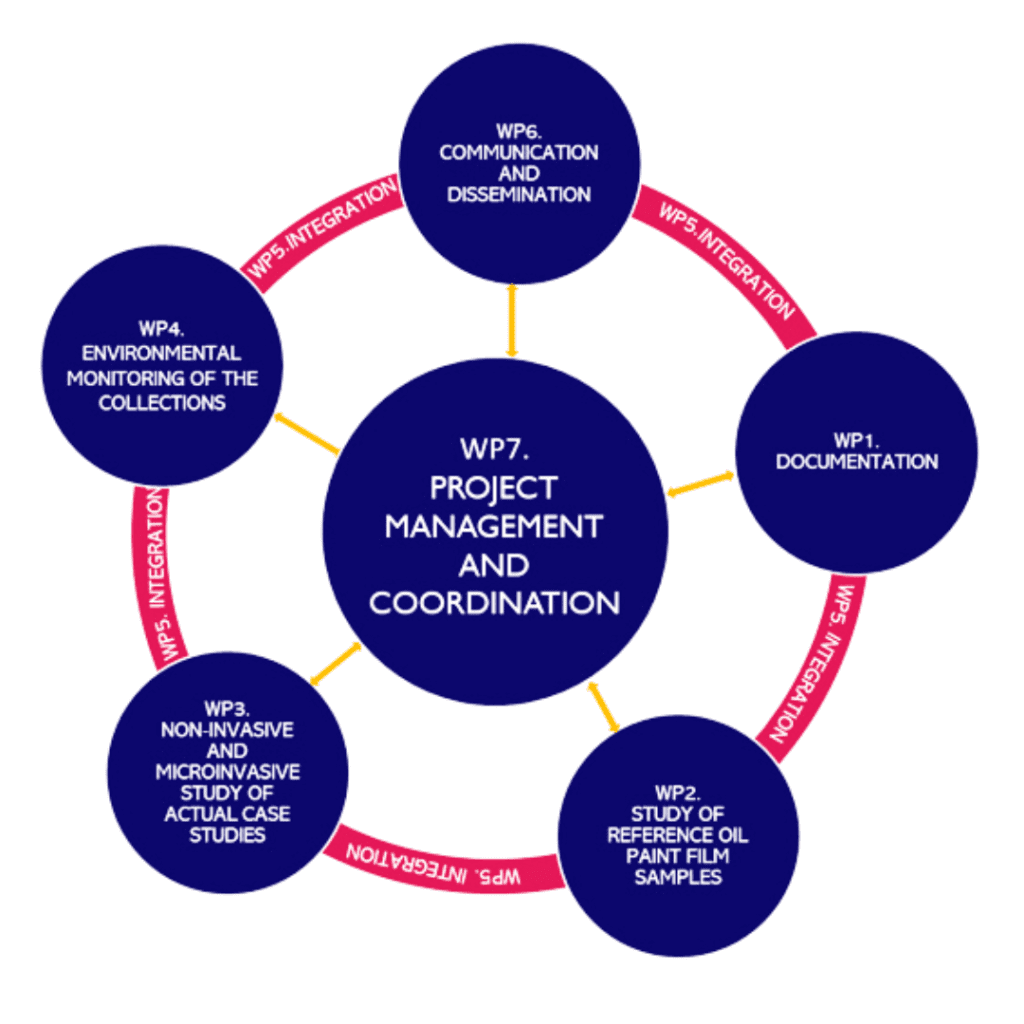
SPAM! project goals will be achieved through 7 interrelated Work Packages (WP), as shown in the Pert chart. As it can be seen, the workplan is framed by WPs dedicated to Project Management and Coordination, Integration as well as Communication & Dissemination, running throughout the whole project duration. The research and innovation content are covered in WPs 1-5 each lead by a different partner. Duration and timing of WPs, tasks, deliverables, milestones, and reporting periods are included in the Gantt chart.
- WP 1 – Documentation
- WP 2 – Study of Reference Oil Paint Film films
- WP 3 – Non-Invasive and Micro-invasive Study of real Case Studies
- WP 4 – Environmental Monitoring of the Collections
- WP 5 – Integration
- WP 6 – Communication and Dissemination
- WP 7 – Project Management and Coordination
Background
Paintings on canvas are complex dynamic structures made of a combination of organic and inorganic materials, often very hygroscopic and exhibiting different properties. Such complexity results in a variety of deterioration phenomena as a function of either the inherent aging of materials and their interaction with environmental conditions and their fluctuations.
Recent research has evidenced the correlation between the composition, drying and ageing of lipid binders and the resulting changes over time of the mechanical properties of oil paint films. As it has been already observed by SPAM! Team in previous studies, the complexity of modern artists’ oil formulations results in a series of specific alterations such as cracks, delamination, wrinkles, water sensitivity, brittleness and/or weakening, which are usually the result of complex pigment-binder interactions that have been scarcely investigated. The study of the mechanisms that trigger the observed alterations is thus an urgent issue to be addressed also to inform conservation practice.
Among such interactions, the study of oil paint films containing modern white pigments offers a very interesting and relevant topic for discussion. Considering that white pigments are present both in paint films and in ground layers, their degradation can have detrimental effects in the stability of the whole painted structure, compromising the long-term preservation of paintings in collections. This is especially relevant in of 19th and 20th century, a transition moment in-between traditional and industrially manufactured grounds, and also in coincidence with the introduction of pigments such as titanium white, zinc white and lithopone to substitute common lead-based grounds that fell into disuse due to toxicity issues by mid-19th century.
The SPAM! project is the organic follow-up of several multidisciplinary projects carried out jointly by the


Material Characterization and Crack Formation in Anglada Camarasa's Paintings on Canvas